By Repotrans admin - Jun 1, 2026
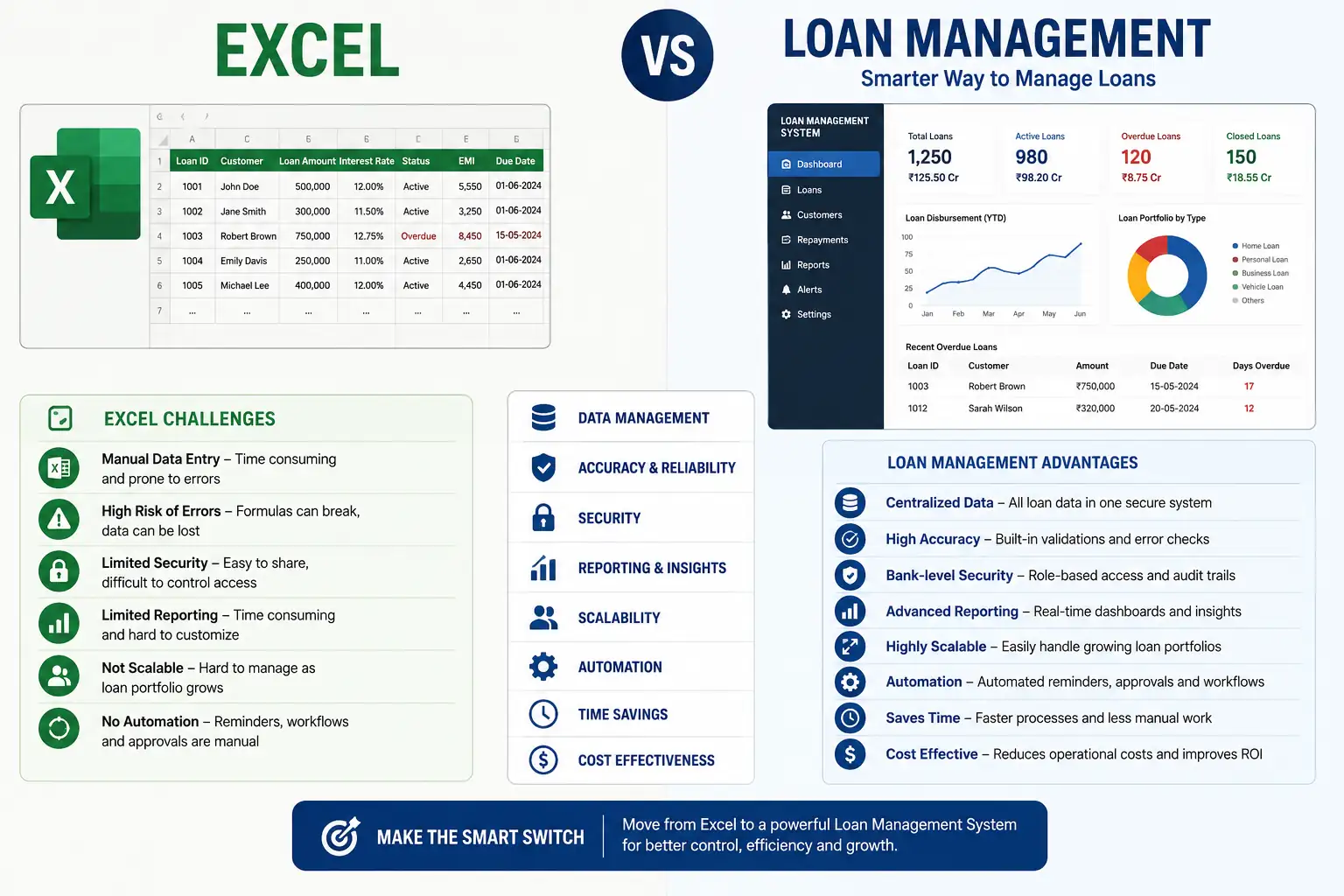
How to Know Your Lending Business Has Outgrown Excel and Needs a Loan Management System
For many microfinance institutions, SACCOs, digital lenders, and community lending groups, Excel is often the first tool used to manage loans.
It is affordable, familiar, and readily available. In the early stages of a lending business, spreadsheets can help track borrowers, loan balances, repayments, and interest calculations.
However, as your loan portfolio grows, Excel can quickly become a bottleneck.
What worked when managing 20 borrowers may become a serious operational risk when managing hundreds or thousands of active loans.
Many lenders continue relying on spreadsheets long after they have reached their limits. Unfortunately, this often leads to calculation errors, delayed reporting, missed repayments, poor customer experiences, and slowed business growth.
The question is not whether Excel is useful—it certainly is.
The real question is whether your lending business has reached the point where spreadsheets are holding you back.
Here are the key signs that your lending business has outgrown Excel and needs a dedicated loan management system.
1. You Spend Too Much Time Updating Loan Records
One of the biggest warning signs is the amount of time your team spends entering and updating data manually.
Every loan repayment requires someone to:
- Open the spreadsheet
- Locate the borrower
- Update balances
- Recalculate interest
- Update arrears
- Verify calculations
When this process is repeated hundreds of times each month, productivity suffers.
Instead of focusing on customer acquisition, loan recovery, and portfolio growth, your staff spend most of their time performing repetitive administrative tasks.
A loan management system automates these processes, allowing repayments, balances, and loan statuses to update automatically.
2. Payment Reconciliation Is Becoming Difficult
As your business grows, tracking repayments manually becomes increasingly challenging.
This problem becomes even more significant when borrowers repay loans through M-Pesa.
Without proper integration, staff must manually compare M-Pesa statements against loan records and update accounts one by one.
Common challenges include:
- Missing payments
- Duplicate entries
- Incorrect borrower allocations
- Delayed account updates
- Increased workload for finance teams
A modern loan management system integrates directly with M-Pesa and automatically matches repayments to the correct borrower.
This dramatically reduces reconciliation time and improves accuracy.
3. You Are Managing Hundreds of Borrowers in One Spreadsheet
Excel performs reasonably well with small datasets.
However, as the number of borrowers increases, spreadsheets become slower and more difficult to manage.
Large loan books often create:
- Slow-loading files
- Complex formulas
- Multiple spreadsheet versions
- Increased risk of corruption
- Difficulty finding information quickly
If your team struggles to navigate loan records efficiently, it may be time to upgrade to a system specifically designed for lending operations.
4. Loan Calculation Errors Are Becoming Common
Even experienced staff can make mistakes.
A single accidental deletion or formula change can affect an entire loan portfolio.
Excel errors often result in:
- Incorrect interest calculations
- Wrong loan balances
- Inaccurate arrears figures
- Customer disputes
- Financial reporting inconsistencies
As your institution grows, these mistakes become increasingly expensive.
A dedicated loan management system automatically applies predefined loan rules and calculations, reducing the risk of human error.
5. You Cannot Track Loan Arrears Effectively
Successful lending depends heavily on monitoring repayment performance.
When managing loans manually, identifying overdue borrowers can become difficult.
Questions such as:
- Who missed their payment this month?
- Which loans are most at risk?
- What is our Portfolio at Risk (PAR)?
- How much is currently in arrears?
should be answerable within seconds.
If your team spends hours generating arrears reports, Excel is no longer serving your needs effectively.
A loan management system automatically tracks overdue loans and generates real-time portfolio reports.
6. Reporting Takes Too Long
Financial reporting is essential for managing a lending institution.
Management teams need regular access to information such as:
- Active loan portfolio
- Interest income
- Loan disbursements
- Collection performance
- Loan arrears
- Cash flow
- Profitability
When using spreadsheets, generating reports often requires manual calculations and extensive data cleaning.
As your business grows, report preparation may take days instead of minutes.
A loan management system generates reports automatically, providing decision-makers with real-time visibility into business performance.
7. Multiple Staff Members Need Access to Loan Data
Excel was not designed for large teams working simultaneously.
As your organization expands, different departments require access to the same information.
Examples include:
- Loan officers
- Branch managers
- Accountants
- Collection officers
- Senior management
Sharing spreadsheets between multiple users often leads to:
- Conflicting versions
- Lost updates
- Data duplication
- Security concerns
Cloud-based loan management systems solve this problem by allowing multiple authorized users to work within the same system simultaneously.
8. You Are Expanding to Multiple Branches
Many lending institutions start from a single office before expanding.
Once multiple branches are involved, spreadsheet management becomes significantly more difficult.
Challenges include:
- Consolidating branch reports
- Tracking branch performance
- Synchronizing borrower information
- Maintaining data consistency
A centralized loan management system provides a single source of truth across all locations.
Management can monitor branch operations from anywhere while maintaining consistent records.
9. Borrowers Expect Digital Services
Today's borrowers are increasingly mobile-first.
Most customers expect:
- Fast loan approvals
- Mobile repayments
- Instant payment confirmations
- SMS notifications
- Digital account updates
If your lending process still relies heavily on manual procedures, customers may choose competitors offering more convenient digital experiences.
A loan management system enables lenders to deliver the level of service modern borrowers expect.
10. Regulatory and Audit Requirements Are Increasing
As lending businesses grow, compliance requirements become more important.
Auditors, investors, and regulators often require accurate and transparent records.
Maintaining audit trails manually can be difficult when using spreadsheets.
Questions such as:
- Who modified a loan record?
- When was a repayment updated?
- What changes were made to borrower accounts?
can be difficult to answer.
A loan management system automatically records user activity and creates detailed audit logs.
11. Business Growth Is Slowing Because of Operations
Perhaps the biggest sign that you have outgrown Excel is when operational challenges begin limiting growth.
Many lenders reach a stage where demand exists, but internal processes cannot keep up.
Staff become overwhelmed.
Loan processing slows down.
Reporting becomes delayed.
Customer complaints increase.
Management loses visibility into portfolio performance.
At this stage, the business is no longer constrained by market demand—it is constrained by its systems.
A loan management system removes these operational bottlenecks and creates a foundation for sustainable growth.
The Hidden Cost of Staying on Excel
Many lending businesses delay upgrading because Excel appears inexpensive.
However, the real costs are often hidden.
These costs include:
- Staff hours spent on manual updates
- Errors in calculations and reporting
- Lost revenue from delayed loan processing
- Poor customer experiences
- Increased loan defaults due to weak monitoring
- Difficulty scaling operations
As your portfolio grows, these inefficiencies become more expensive than investing in the right technology.
The longer a lender waits to modernize operations, the greater the risk of operational challenges affecting profitability.
What a Modern Loan Management System Should Provide
If you decide to move beyond spreadsheets, look for a system that offers:
- M-Pesa integration
- Automated payment reconciliation
- Loan disbursement management
- Arrears tracking
- Portfolio performance reporting
- Financial reporting
- SMS notifications
- Role-based access control
- Cloud-based access
- Audit trails
- Multi-branch support
- Custom loan products
These features help lenders automate operations while improving efficiency and accuracy.
How Repotrans Tech Solutions Helps Lenders Scale
At Repotrans Tech Solutions, we help microfinance institutions, SACCOs, and lending businesses move beyond spreadsheets and manual processes.
Our Microfinance Management System is designed to automate lending operations through:
- Automated loan management
- M-Pesa integration
- Real-time payment reconciliation
- Loan recovery tracking
- Financial reporting
- SMS notifications
- Multi-user access
- Cloud-based accessibility
Whether you manage 100 loans or 100,000 loans, the right technology can help you operate more efficiently while improving customer experience and loan portfolio performance.
Final Thoughts
Excel is an excellent starting point for many lending businesses.
However, every successful lender eventually reaches a stage where spreadsheets create more problems than they solve.
If your team spends hours updating records, reconciling payments, generating reports, or tracking arrears, these are clear signs that your business has outgrown Excel.
Investing in a dedicated loan management system is not simply a technology upgrade—it is a strategic investment in operational efficiency, improved loan recovery, better customer service, and long-term growth.
The sooner you make the transition, the sooner your team can focus on what matters most: growing a healthy and profitable loan portfolio.
Built for SACCOs, chamas, and microfinance institutions embracing technology across Kenya and Africa.
